Thanks to the dedicated commitment of Christopher Gunning, who is currently undertaking his Work Integrated Learning with B4C, and Nick Johnson, a recently joined volunteer with a particular interest in freshwater ecosystems, B4C has established a rare native fish breeding program at the B4C Sustainability Centre.
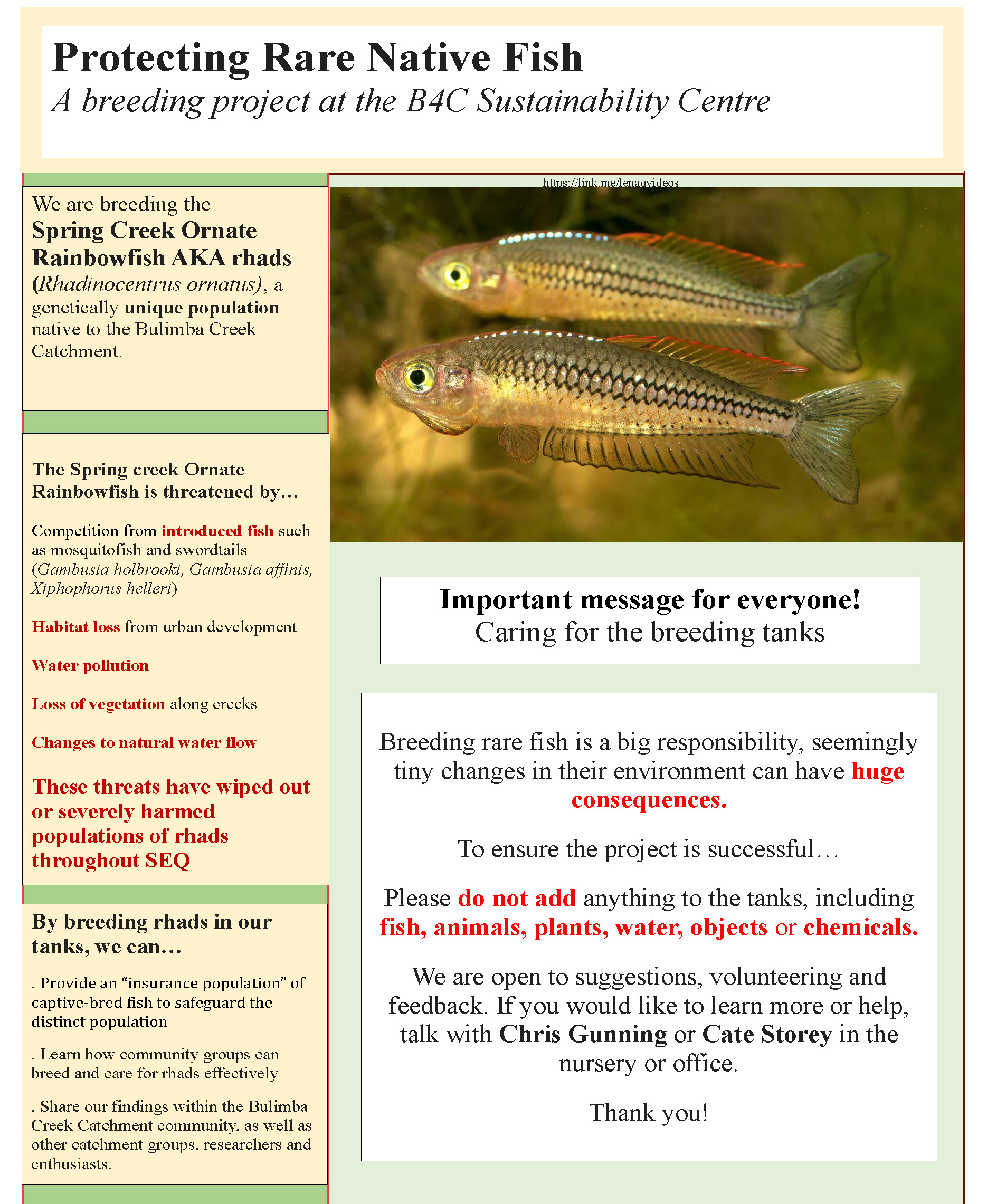
Late last year, Christopher introduced endangered Honey Blue-eyes (Pseudomugil mellis) into the back pond, where they are now breeding successfully. Earlier this year, Christopher also established a breeding program for the Spring Creek Ornate Rainbowfish, also known as rhads (Rhadinocentrus ornatus), a genetically unique population native to the Bulimba Creek catchment.
These beautiful freshwater fish face serious threats across South-East Queensland, including habitat loss, water pollution, loss of creekside vegetation, altered water flows and competition from introduced fish species such as mosquitofish and swordtails. In many areas, these pressures have severely reduced or completely wiped out local populations.
The breeding program aims to create an “insurance population” of captive-bred fish, while also helping community groups better understand how to successfully breed and care for rare native fish. Over time, B4C hopes to share knowledge and findings with other catchment groups, researchers and enthusiasts.
Community engagement has been an important part of the project. To help involve volunteers and supporters, children’s author Steve Baines recently held a community workshop where children learnt about endangered freshwater species, helped make spawning mops for the breeding tanks and planted aquatic vegetation to support healthy pond ecosystems.
B4C has also consulted with ecologist Rob Wager, who previously rediscovered and bred the Spring Creek rhads, helping guide the development of the program.
Because breeding rare fish is a significant responsibility, volunteers are reminded not to add anything to the breeding ponds or tanks, including plants, animals, water, chemicals or objects, as even very small environmental changes can have major impacts on these sensitive species.